Showing posts with label Movies. Show all posts

Sunday, February 21, 2016

The Revenant (2015)


Rating:  **

About a half-hour into Alejandro Iñárritu’s film The Revenant, Leonardo DiCaprio’s character, Hugh Glass, is mauled repeatedly by an 800-pound grizzly bear, and survives.

And I’m thinking, there is no way, there is absolutely NO WAY he could’ve survived such attack.

In fact, it’s not even a question of whether he’d be alive, but rather how many pieces he’d have been torn into.

This moment requires such an outrageous suspension of disbelief that there’s simply no way any sensible viewer can buy what comes after (and there’s still a good two hours of the film to go). But Iñárritu makes it easy to sustain said incredulity; he drags his half-alive main character through all manner of peril, ranging from a free-fall, river-rapids plummet to the riding off a cliff where his fall is broken by a towering evergreen (his horse is not so lucky). And all of this amid freezing winter temperatures and the extreme likelihood that the wounds he incurred would surely become fatally infectious.

This is the main issue that dogs Iñárritu’s wildly overpraised film, but there are others. It dreams of being a stark, spare historical epic, but in reality it more closeky echoes a made-for-History Chanel telemovie, exploiting its brutality in the name of historical veracity, and wallowing in ugliness for nearly three hours in the name of art. The Glass character is meant to be a lone, suffering protagonist who’s meant to make a statement about revenge with his ultimate decision not to kill (only after a prolonged, bloody hatchet fight during which he almost slew his nemesis). But ultimately there s no point, no message, no purpose, and if there is it’s buried under about three feet of blood, snow and mud.

We know we’re in trouble at the outset. At some point in the early nineteenth century, somewhere in the wooded Northern Plains of America, a band of wooly fur trappers are ambushed by Indians. It’s a bloodbath, and Iñárritu directs it like Spielberg’s opening D-Day battle in Saving Private Ryan: deadeye arrows piercing throats, muskets shot in retaliation. Even a horse buys it to show how unthinkingly brutal these unwashed heathens were (never mind that horses were a valuable commodity, and neither side would’ve demonstrated such wanton waste).  The survivors leave to trundle on, led by Glass and a bearded crumb named Fitzgerald. You can tell this guy is bad right away, and Tom Hardly’s portrayal of him is as lacking in subtlety as it is intelligibility – I dare anyone to decipher and more than three consecutive words of his dialogue.

[If you’ll allow a brief digression, let me tell you my biggest pet peeve in a historical work: inaccuracy. In addition to the aforementioned Indian assault, staged too much like a scene of modern warfare (woodland tribes’ fighting more closely resembled sniping and guerilla attacks), I was bothered by Fitzgerald’s profanity, particularly his liberal dropping f the f-bomb and references to female body parts – words not part of common parlance until the twentieth century. This is screenwriter’s laziness: it reveals their cynical assumption that most viewers either don’t know or care about history, as well as their readiness to juice up as much scatology as possible for fear that audiences won’t find the story interesting otherwise (and for this can the writers truly be blamed?]

And now, back to the story. The bear attack, of course. DiCaprio’s pretty messed up. Fitzgerald wants to finish him off, but DiCaprio’s half-breed son, Hawk, demurs, as does some other dude named Bridger (sort of the apple-cheeked naïf whom we know will represent the good to Fitz’s evil). But Fitz kills Hawk, with DiCaprio watching but helpless to do anything. Fitz and Bridger slog off on their own, distrusting each other, until they get to a fort. DiCaprio slogs off on his own (albeit far more slowly), encounters more brutality involving settlers and Indians until he finally confronts Fitz. They wrestle, slash each other’s limbs, bleed in the snow, and generally have a messy time of it all until DiCaprio frees Fitz from his clenches, and discards him mercifully to the Indians, who do the stereotypical scalping thing before serving up his just desserts. DiCapio winsomely slogs some more, seeing a vision of his wife in the ether.  

I must say that my distaste for The Revenant surprised me, given that I lauded Iñárritu’s previous film Birdman. But that film had a spectacularly literate screenplay, cowritten by Iñárritu and his Biutiful scribes. Iñárritu co-adapted Revenant with Mark L. Smith, the writer of the two horror films Vacancy and Vacancy 2, and that makes sense. The Revenant, despite its well-mounted look, has the heart and soul of a slasher film: I haven’t seen this much carnal abuse masquerading as art since a tsunami-soaked Naomi Watts wandered half-dead for the near entirety of The Impossible (also written/directed by horror talents). But this may even be doing a disservice to horror: unlike most good examples of the genre, The Revenant wallows in its misery for no good purpose, and exploits its brutality with little or no justification outside mere entertainment.

Much praise has been heaped upon the cinematography of the film, and, yes, many shots look good, reminding me of the works of Terrence Malick and the way he captures the majesty of the American landscape in all its towering glory. But for what do these photographic compositions serve, given the unsavory characters who people them? Sure, Doctor Zhivago captured snow-laden trees and icy vistas with sheer magnificence, but what drove those images was the romance of Lara and Yuri, and their life’s development over the course of three decades. The Revenant has barely discernable characterizations, let alone their development, and so the look of the film all but becomes an entirely moot point.

DiCaprio appears to be the front runner for Best Actor – I suppose voters applaud actors who get down and dirty (literally) for their craft. But with minimal dialogue and limited physicality, his performance is all manner; there’s nothing there to occupy the mind, and certainly nothing to engage the emotion. And with a Golden Globe win for Best Picture, the actual film looks to be favored to win as well. That part mystifies me. With so many worthier contenders, and a few that weren’t even nominated, a win for this overhyped exercise in drudgery would be a real downer come Oscar night. Yes, even more of a downer than watching the film itself.


Tuesday, February 16, 2016

The Big Short (2015)


Rating:  ** 

The Big Short is based on a nonfiction book about the Big Crash of 2008. Director Adam McKay, famous for his Will Farrell comedies, adapted the book to screen as a fiction film, replacing real figures with more dramatized, name-changed characters. McKay, known for far broader material than this, must’ve known he was against the wall in making a lot of white-collar, business-babble palatable to mainstream audiences. He even commences his task by featuring a blonde in a bathtub, breaking the fourth wall (it happens a lot in this movie), explaining the idea behind sub-prime mortgages.

Why, then, in the name of holy hell, did he even want to make this movie?

I’ve got no idea. And I’ll be honest: I’m completely bored by business. I can count the number of films about big business that I’ve liked on one hand. They generally try to make a point that isn’t enlightening to me, using characters I don’t care about, employing a plot that usually confuses me as much as it bores me. And one usually begets the other.

We pretty much get a cavalcade of twenty or thirtysomething white guys, played by such Hollywood stars as Christian Bale and Steve Carrell, yakking away in the years just before the bubble burst on Wall Street, plunging the country into Recesssion and making the phrase “Too big to fail” common parlance. The men (and they’re ALL men, except for a few female sex objects) couldn’t be any less consequential – they’re pretentious, obnoxious, boring, unlikeable talking heads that repelled me ways reminiscent of the cast of HBO’s Entourage. And the cable analogy is apt; the production feels completely influenced by the pay-TV stylistic – no scenes, pseudo-intellectual dialogue, slick but choppy cutting, and a thin layer of gloss over everything to impart a false sense of importance.

I was also reminded of TV’s The Office – yes, it’s directed like a fake documentary (for no apparent reason), as well as the highly superior real documentary on the same subject Inside Job (that film also featured songs and images from the era to enhance time-period verisimilitude, something The Big Short apes, unsuccessfully). And let’s also remember the phenomenal documentary The Smartest Guys in the Room, about the Enron crisis. Hmm, perhaps I do like the subject matter, but find fictional accounts too contrived. Perhaps it’s truth that’s more interesting to me, at least in this regard.

In the end, we spend over two hours watching these f-bomb spewing suits heading toward the cliff. McKay never condemns or even questions their behavior, and if he’s glamorizing them, why? There’s no depth or discussion-provoking analysis. By the time we get to the final act, we’re just counting up the number of ways he’s trying explain to us byzantine fiscal matters (the cleverness of utilizing Anthony Bordain and Selena Gomez notwithstanding). After a while, it almost feels like he’s even apologizing for having to take the time to do such explanation.

I suppose I got that the world of big business is pretty damned cutthroat, in ways that we common folk can’t possibly fathom.

There could be a great movie on that topic. The Big Short isn’t it.


Sunday, January 31, 2016

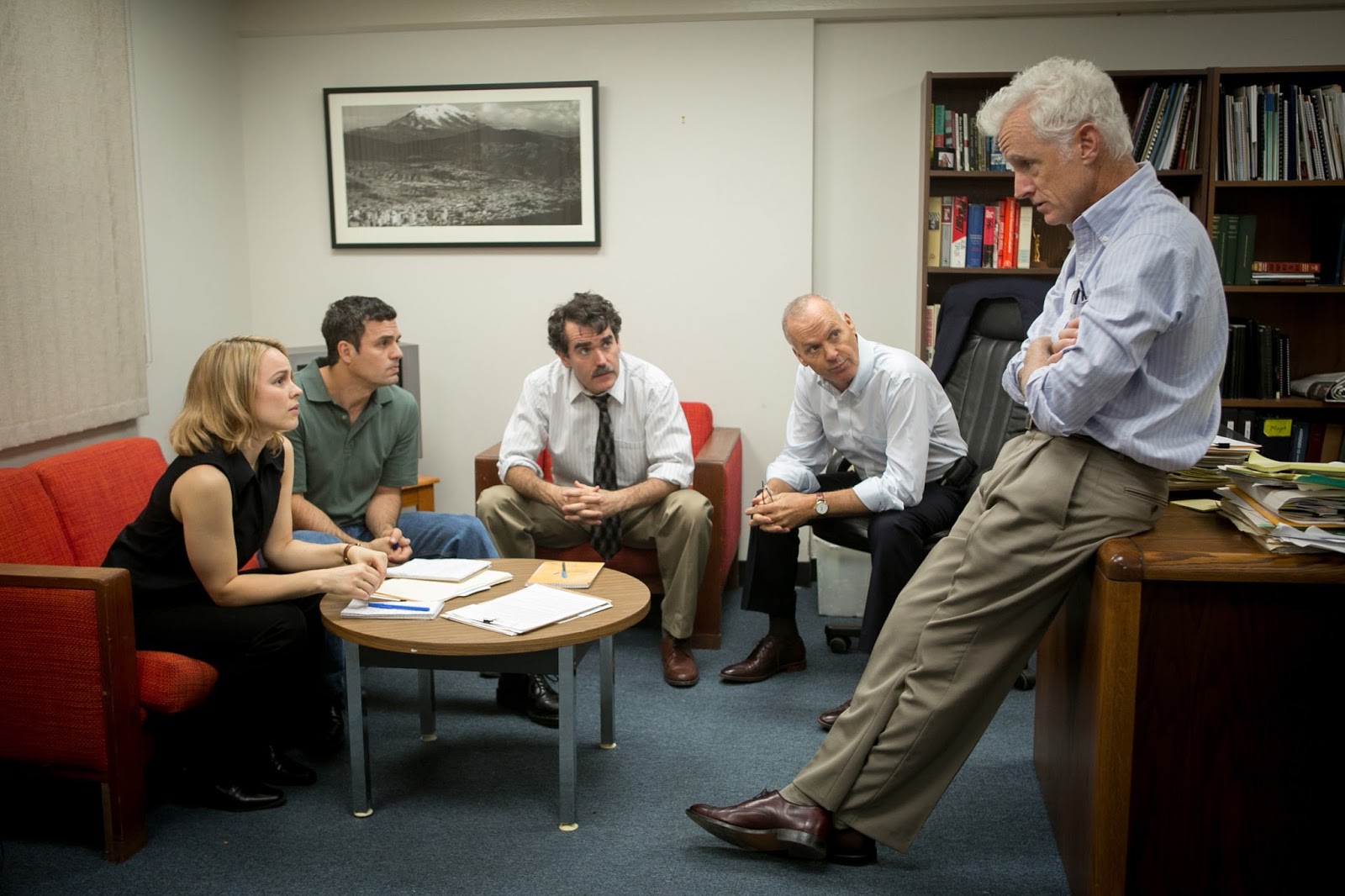
Spotlight (2015)

Rating: ***1/2


Spotlight made me nostalgic.

Once upon a time, primarily in the late-70s and early 80s, movies weren’t afraid to confront real topics with intelligent screenplays involving intelligent characters. They considered events involving politics, journalism, law, education, etc., and told stories that respected the intelligence of their viewers. Movies like All the President’s Men, Absence of Malice, And Justice For All and The Verdict, cinemastuff which worked our cranial cavities like professors challenging their students. We felt like adults, not just movie patrons, but folk who felt alive with the simultaneous engagement of being amply entertained and getting the chance to figure out the pieces of a puzzle. A meaningful puzzle.

Then the mid-eighties enforced the blockbuster mentality on all mainstream cinema, and those types of pictures disappeared from view, replaced with utter vapidity during the summers, and more “meaningful” works at the end of the year as Oscar bait. The low-key, incisive, cerebral film was out of fashion – any last traces of it were completely obliterated as the 90s rolled around, and digital technology destroyed the attention span necessary for the maintenance of such a picture.

So when a film comes along like Spotlight, a paper-trail story about investigative newspaper reporters uncovering the Catholic Church molestation scandal of 2001, it reinvigorates my optimism. It has all the watermarks of the films I mentioned earlier, but we’re living in a day and age when clarity and complexity are rarely seen together in a movie, so to achieve both and confront something meaningful and socially relevant is as rare as it is admirable.

Clearly he star of this film is the screenplay, and it deftly manages to lead the viewer throughout a labyrinthine, thinking-man’s whodunit with just the right dramatic rhythms. We all know the standard-issue scenes of this genre: the reporters looking at microfiche in the library, making copies, phone calls, having meetings – you know, all the exciting stuff. But the characterizations are all clear, distinct and richly-drawn, so we follow them easily, regardless of their actions.

And the dialogue is sharply resonant; it doesn’t fall for the usual histrionic clichés. We really feel like these are the conversations that go on at a major newspaper. The new editor-in-chief, played by Liev Schreiber (bearded, and looking like a 70s Richard Masur), doesn’t come in with both barrels. He doesn’t force the “Spotllight” team to do anything; rather, he suggests that to increase readership they ought to cover the stories that matter to the average subscriber. Accordingly, there’s a scene in which one reporter notices an accused priest lives nearby, all-too close to his own, vulnerable family. He goes to Keaton, unsure if he can stand waiting for the paper to strike at just the right moment with the story. Keaton, rather than respond with the standard, “We’ve got a paper to run; that’s the important thing” line we’d expect in a lesser film, instead answers, calmly, "It will happen soon." Again, real.

Some people don’t think the film’s director, Tom McCarthy, deserved his Oscar nomination in that category, but I beg to differ. He had the daunting task of juggling all the performances and scenes (and there are dozens, in this two-hour-plus movie) so they didn’t wind up as a big mess on the screen. And he does not fall prey to the unfortunate trend in wordy movies of late: having the characters talk so fast, and so artificially, that you have no idea what’s going on, and don’t particularly care either (lots of audiences mistake this for “sharp” or “witty”). McCarthy gives his dialogue plenty of breathing room – you can digest their lines, and think about their ideas afterward. Film should be no different from live theater in this regard, yet it so often is.


The film also wisely steers clear of the more graphic elements of its subject matter, realizing it would impart an entirely different tone. Not that it's not an important issue to deal with - it most certainly is - but that's a different movie (that, in fact, would be a documentary called Deliver Us From Evil, a harrowing portrait of a Catholic priest whose crimes were covered up by the church for decades). The few scenes in Spotlight that inform us of the urgency of the newspaper's mission are enough to get the point across. 

A few quibbles: with so many similar, pressed-together performances, you can see which ones shine, which are serviceable, and which simply pale in comparison – it is those of the latter category (I won’t name names) which bring the whole thing down just a few pegs. And I also think a few, strategically placed moments where characters emote just a bit, perhaps from all the pressure of their jobs, would’ve served the story well. Toward the end especially we’re somewhat jaded by all the shop-talk, and it limits our investment in their quest, and ultimately whether or not they succeed.

But overall, fine work. And remember, there was a time, boys and girls, when Hollywood specialized in these sorts of films. Go back and rent a few of ‘em; you might be surprised.


Thursday, January 21, 2016

Ex Machina (2015)

Rating:  **1/2


Basically, Ex Machina is about a computer engineer who builds a female robot, then brings in a young man to see if she has the intelligence to escape.

Why in the hell would a man, ostensibly spending the better part of his entire life designing and building this thing, want to do that? So right off the bat, the film’s premise seems quite ridiculous.

In all fairness, we don’t learn this until the well into the film’s third act, when the film gets all twisty and turny with surprises and revelations that seem to be in fashion with today’s overwritten screenplays. But Ex Machina’s first hour promises some serious exploration on the subject of artificial intelligence, even though we’re introduced to Ava (the AI) far too early to develop any meaningful suspense. Combined with lush striking cinematography (of the designer’s fantastic workplace overlooking breathtaking scenery), and some nifty digital effects that are not overused, at least not at first anyway, the film starts rather intriguing.

But then it becomes clear the film isn’t much interesting in having a meaningful discussion on AI. The dialogue is heavy on information, but it’s all just window dressing: flat technospeak intended to lend credibility to the two lead characters. Instead it comes off as writer’s posturing. When Caleb, the contest winner who gets to “test” Ava, asks Nathan, the designer, why he isn’t part of a true Turing Test (when the tester doesn’t know whether or not he is talking to a computer), he isn’t given much of an answer. Nor is he for his query as to why Ava is given sexuality. Comparisons to the artist Jackson Pollack and predictions out the future of AI/human relations are dead-ends too.

And the characters aren’t particularly credible, either. At no point did I actually believe Ava was a robot, nor, for that matter, did Nathan convince me her was her builder. He spends most of the film drinking beer, lifting weights, getting pissed off, looking at all his surveillance monitors and spouting snippy phrases that are supposed to make him look intelligent. Only Caleb seems right as the contest winner, but how much praise is it that he plays a blank slate pretty well?

This surprising shallowness makes sense once we get to the big “twist,” at which time we realize it was all but a setup. And then we get some messy plot baggage involving how far Nathan has really gone with his AI toys, particularly with those of the female persuasion (really just an excuse for a lot of nudity). I won’t spoil the ending, but let’s just say things go South pretty badly for our fanatical programmer. And the very ending is clever enough, but it thusly turns the theme of the film into more of a cautionary parable than a novel-based story.

But it’s all in keeping with what the film truly wants: to be diverting entertainment. On that basis, it succeeds well enough. But it won’t be compared to AI classics like The Stepford Wives, Westworld, or more recently, A.I. or Her anytime soon.


Wednesday, January 20, 2016

Carol (2015)

Rating: ****


Director Todd Haynes has a real love/hate relationship with the 50s. He’s at once entranced by its style: the classy assortment of pastel hues on cars and wallpaper designs mixed up with the equally classy clothes and jazzy tunes of the time. But he also bemoans the oppression that came with it, the stifling of women and homosexuals that lay below the prettified exteriors. His brilliant 2002 film Far From Heaven showed this dichotomy. It was an ethereal mood piece, done in the style of classic film pulp from the era, but exposing all its hypocrisies and double standards.

Now, thirteen years later, Haynes treads similar turf with his newest film, Carol, also the name of a well-heeled New York lesbian (Cate Blanchett), divorcing her husband, who develops a romance with a department store clerk named Therese (Rooney Mara) around Christmastime. Carol husband is fighting her for custody of her daughter, and when he gets incriminating evidence of his wife’s dalliances with the new girl in her life, Carol is left without a leg to stand on. The girl, an aspiring photographer, is shattered when the relationship looks to be at and end, and so Carol’s dilemma appears to be a choice between the two true loves of her life.


I wouldn’t dream of disclosing the ending, but I will say it feels like a realistic ending, separate from any sense of politics or dramatic grandstanding, or get-what-you-deserve existentialism. There aren’t any obvious statements, either, like the ones in Heaven, nor does it possess that film’s savage ironies.

.No, Carol is first and foremost, a love story. The commentaries this time are subtle, meant to be subordinate to the emotional connection between Carol and Therese. What we get is a steadily involving, and evolving, love story – the impediments to its fulfillment are no different really, from those in any other film of this ilk. Haynes keeps his signature, surreal style intact, and here it works to chronicle Therese’s odyssey of bliss – but also confusion. The word “lesbian” is never once uttered in the entire film; it wasn’t part of common parlance yet, but more importantly, Therese wouldn’t know what one is. All her awareness allows her is that one human being gratifies her sexually, emotionally and intellectually. As such, she becomes the perfect metaphor for love, regardless of gender or orientation, and regardless of era

I also admire how Haynes respects his characters’ intelligence. As intolerant as his male characters are, they’re not stupid brutes either, so we don’t waste screen time having them do the ABC’ of same-sex relationships. And Therese, though depicted as a shy ingénue, also knows want she wants, and doesn’t have to go through the whole rigmarole of being seduced. This is the work of a mature artist, dealing with once-taboo subject matter just as maturely.

And I thank God we still have filmmakers like this, apart from the sniveling, schoolboyish (and generally male) purveyors of Hollywood product these days. Hayes’ films are handcrafted works of both style and clarity – and both in the service of character. When you watch something from folks of this grain, you  get a visceral feeling of passion. They want to tell these stories. Badly. And I, for one, want to watch.

Tuesday, April 23, 2013

Not Your Father's (or Grandfather's) James Bond


Skyfall  **1/2 (out of four)


Ever since the Cold War ended, the producers of the James Bond films have bent over backwards trying to make the character … relevant. After all, no climate for a murderous double agent could’ve been better than a world divided, where brinksmanship all depends on secrecy and espionage. When the Berlin Wall fell in 1989, so did the Bond franchise, and it would be 6 years before the next installment, Goldeneye, hit theatres. The trademarks were back  - the cars, the drinks, the women – but the purpose wasn’t quite there; the villains still wanted to take over the world, but in an uncertain world, where the good and bad had no iron curtain to define them. Yes, Tomorrow Never Dies featured a head-baddie as a deranged Ted Turner-type megalomaniac (perfect for the mid-90s age of round the clock cable news coverage), but it did seem a bit contrived.


When Daniel Craig took over the role in 2006 he had a tall order – to rejuvenate the character, franchise and studio. In a post-9/11 world, the clear threat had to come from rogue-nation terrorism. And now in Skyfall, the 22nd Bond film, all the ingredients match up with a world that bears all but a slight resemblance to the one inhabited by Sean Connery’s Bond over 40 years ago. Here, gadget inventor Q is a young technophile who briefs Bond on all his newest gadgets like a teenager explaining to his father how the newest i-phone can attach video to a email. Moneypenny is no longer M’s secretary but an agent herself, an African-American female who actually “kills” 007 in the gargantuan pre-credit sequence. And the villain this time is a weird psychopath, in keeping with the modern tendency to make the bad guys less Grand Guignol and more just plain sick, as in Heath Ledger’s Joker from Batman Forever and Hannibal Lechter from The Silence of the Lambs (the latter even more directly copied when Skyfall’s villain is incarcerated in an isolated holding chamber, which of course he escapes from). Oh, and did I mention that he’s also a skilled cyberhacker?

About halfway through, we finally get some of the traditional Bond trademarks: the exotic locales, the Bond girls – oh, I mean women (it’s true, that’s what they’re officially called now, according to the press release), and greater use of the classic Monty Norman Bond theme. But it’s almost like throwing a bone to the Bond purists among us – Skyfall is just too danged serious, and I would never in a million years consider this escapist entertainment. (Yes, you’re probably by now suggesting that those old-time Bonds were realistic for their time, but they weren’t – in fact, many critics felt their silliness rendered them inferior to their Ian Fleming source material.) Even the violence level is stressful here. I know the Bond films have always been violent, but in Skyfall the violence is not just more frequent but also more realistically intense – the sort you’d find in a war movie (in fact, the film’s climax, a full-scale nighttime assault on a Scottish castle, reminded me of the gritty finale of Zero Dark Thirty, in which Osama Bin Laden is killed). Perhaps I’m more sensitive to violence in an age where mass-shootings where 100-plus rounds are unloaded is the norm. Or perhaps the action films are budgeted and technologically-equipped now so as to show greater carnage than before. Probably both.


I mentioned the villain earlier, and he’s played by Javier Barden, employing many of the same creepy nuances he did in his Oscar-winning performance in No Country for Old Men. This time, he uses he uses his vocal mannerisms for chilling effect, flirting with Bond in one scene, callously shooting his love interest in cold blood in the next. He’s the best thing in Skyfall, and it’s probably a mistake to delay his introduction until around the second half of the film. He’s the sort of villain, though, that you want DEAD, not charming the pants off Bond while a gold-powered laser beam inches closer to his privates, or stroking a pussycat while pressing buttons to release trap doors. So in that sense, he’s effective.

Just give him to me in a different movie. Right now, I’m going back to watch You Only Live Twice. And not be stressed out.

Related Posts Plugin for WordPress, Blogger...